
Moscow Does Not Believe in Tariffs: Measuring the Prospects of Indonesia-EAEU FTA Implementation in 2026-2027
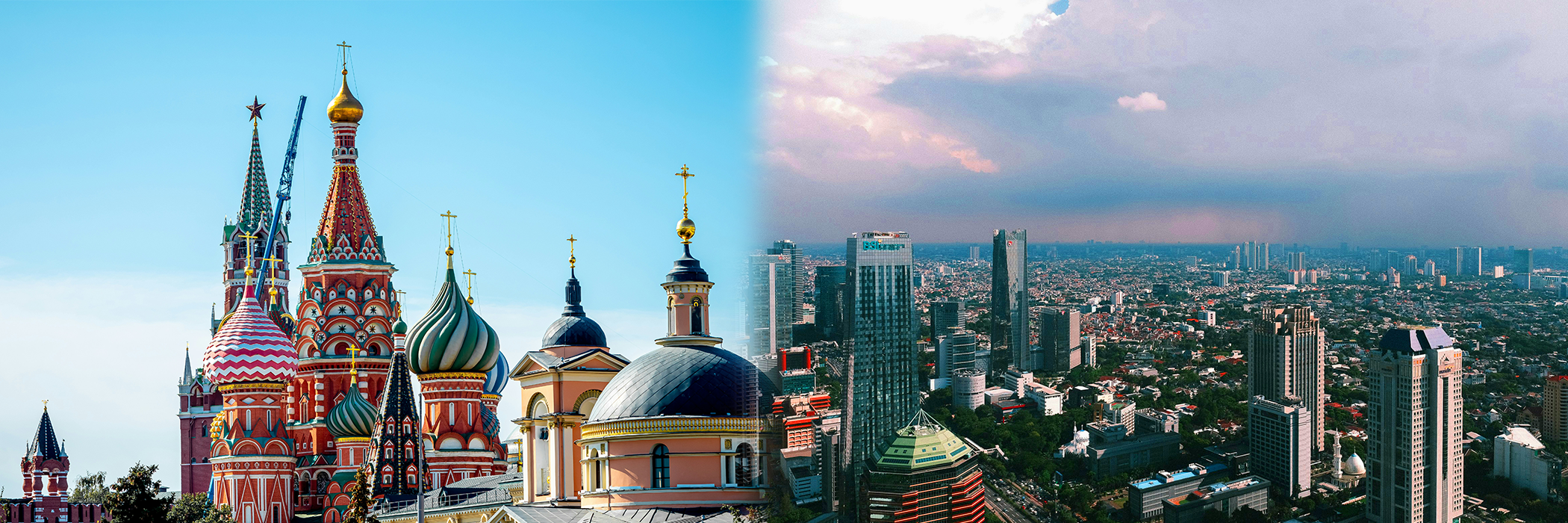
Indonesia’s newly signed free trade agreement with the Eurasian Economic Union (EAEU) arrives at an uncertain moment: not because of tariffs, but because of Russia itself. As the bloc’s economic center of gravity faces mounting structural pressures, the effectiveness of tariff liberalisation becomes less a question of access—and more a question of demand.
December 2025, St. Petersburg
In December 2025, Indonesia and the EAEU signed a free trade agreement (FTA) in order to bolster two-way trade between them. Indonesian Trade Minister Budi Santoso represented the world’s largest archipelago during the signing in St. Petersburg, an occasion that was directly witnessed by Russian President Vladimir Putin and leaders of other EAEU member states (Armenia, Belarus, Kazakhstan, and Kyrgyzstan).
Signed following a two-year negotiation, the agreement grants Indonesia preferential tariff treatment on 90.5% of its tariff lines in the EAEU market, opening access to a region with a population of approximately 180 million people. Included in Indonesia’s key exports to the EAEU countries like palm oil and coffee — commodities that are central to the country’s agricultural export base and contribute to rural incomes and foreign exchange earnings, with palm oil alone being one of Indonesia’s largest plantation export earners.
After this FTA signing, Alexander Masaltsev, Russia's Trade Representative in Indonesia, encouraged Moscow to treat Jakarta as a profitable trading partner after he noted that Russian exporters would obtain preferential tariff treatment covering roughly 90% of Indonesia’s tariff lines under the agreement. For covered products, Indonesia’s average applied import tariff is expected to decline from 7.6% to around 1.5%. He also mentioned the possibility of expanding bilateral settlement and barter mechanisms. While bilateral trade has thus far been dominated by commodities, Moscow identified agriculture, heavy machinery, energy equipment, information technology, and pharmaceuticals as priority sectors for diversification and higher value-added cooperation.
Russia’s Economic Woes
While both Jakarta and Moscow understandably like the promises this FTA holds, a deeper examination reveals that the immediate fruits that can be reaped from this FTA highly depends on the state of Russian economy in 2026-2027. Even more so since the economic performance of the whole EAEU bloc really hinges on Russia’s economic performance. In other words, this means that when Russia slows, the entire bloc feels it—often immediately.
For example, in 2024, in the middle of Russia’s ongoing invasion of Ukraine, Russia’s GDP was still ten times larger than the second largest economy in the bloc, Kazakhstan. This pattern is evident in the economies of the bloc’s other member states. By 2025, as much as 93% of intra-EAEU trade was settled in national currencies, predominantly in Russian rubles that accounted for around 75% of all mutual settlements.
In aggregate, the EAEU is unlike more balanced trading blocs like ASEAN or the EU. In the EAEU, Russia is the economic center of gravity of the bloc, while other countries’ economies remain relatively small compared to Russia’s. This implies that economic fluctuations in Russia significantly shape the EAEU’s aggregate GDP, trade flows, and demand conditions—factors that will directly affect the commercial viability of the FTA.
This is a dire reality for the Kremlin because, in November 2025, after two years of growth driven by large-scale military spending, the Russian economy was showing signs of deceleration. According to Russia’s Center for Macroeconomic Analysis and Short-Term Forecasting, the combination of fiscal tightening and restrictive monetary policy could push the economy into decline before mid-2026. In macroeconomic terms, simultaneous fiscal consolidation and monetary tightening reduce aggregate demand, increasing the likelihood of recession.
To add, some external assessments have stressed that a hypothetical ending to Russia’s invasion of Ukraine would not necessarily revive the Russian economy. They contend that declining household incomes, falling industrial output, and diminishing military orders could instead deepen the crisis.
Furthermore, as 2026 begins, multiple assessments indicate that Russia’s wartime economy is facing pressure from several directions. First, analysts note that tight monetary policy—characterized by elevated interest rates—and continued reductions in non-military budget spending are being maintained to preserve macroeconomic stability, but at the cost of slowing growth. Second, sanctions-related import restrictions are accelerating the technological depreciation of capital goods, as limited access to Western machinery and components constrains industrial modernization and productivity growth. Third, sustained wartime expenditures continue to deplete fiscal buffers, labor supply, and material resources. As German Gref, CEO of Sberbank, warned back in September 2025, Russia had already entered what he described as a phase of “technical stagnation.”
Three Potential Scenarios
Against this backdrop, the evolution of Russia’s economy in 2026–2027 can be understood through a set of escalating scenarios. These scenarios must now be read against a more volatile external environment, where elevated energy prices provide short-term fiscal relief while simultaneously increasing exposure to geopolitical shocks.
The first scenario is hence Russia’s economy accomplishing a constrained stabilization in 2026-2027. That is to say, the Kremlin manages to maintain macroeconomic stability and ensure that Russia’s 2026-2027 economy avoids major shocks, but is likewise unable to return to a strong growth trajectory. Indonesia’s chances to benefit from the FTA will be smaller than the tariff-based market access gains envisaged in the agreement because demand from the EAEU market bloc will only grow slowly, while non-tariff transaction costs (such as logistics, payments, and insurance) remain higher than those of other trading partners. In other words, the newly signed FTA between Indonesia and the EAEU can be an additional avenue for export market diversification beyond Indonesia’s traditional partners in East Asia, the EU, and North America for policy, rather than as a transformative driver capable of significantly reshaping Indonesia’s overall trade structure.
The next one entails a gradual intensification of economic pressures beyond mere stabilization in 2026-2027. Some analysts project that Russia’s GDP growth could slow to around or below 1 percent in 2026, reflecting weakening momentum and persistent economic constraints. To add, fiscal resources would be increasingly directed toward defense spending and short-term stabilization measures rather than long-term productive investment. For Indonesia, this would likely translate into low effective utilization of the Indonesia–EAEU FTA. Even if preferential tariff reductions are formally in place, subdued demand across the EAEU would limit incentives for export expansion. Moreover, financial and business service sanctions—including prohibitions affecting certain banking transactions and international financial messaging systems—continue to raise regulatory and settlement risks for firms trading with Russia, thereby increasing transaction costs and discouraging deeper commercial engagement.
At the more severe end of this spectrum, geopolitical fragmentation could deepen further. External pressures for the Kremlin will be heightened, mainly due to tightening sanctions, and Russia will have to face an even more limited economic connectivity with the rest of the world. This will influence not only the volume of trade, but also legal and operational certainty. The Indonesia-EAEU FTA will then be present only marginally because its practical economic relevance would be significantly diminished.
After Hormuz
In April 2026, Indonesia and Russia agreed to strengthen cooperations in a variety of sectors by using the momentum gained from the signing of this FTA. Nonetheless, developments in March 2026 complicate this pessimistic outlook. The escalation of tensions involving Iran, the US, and Israel has driven global oil prices upward, temporarily boosting Russia’s hydrocarbon revenues. In the short term, this external windfall may partially offset domestic economic pressures, sustaining fiscal capacity and external trade flows. Yet this relief remains fragile. Ukrainian attacks targeting Russian energy infrastructure, alongside continued sanctions constraints, introduce significant uncertainty over the durability of these gains.
In this context, the Indonesia–EAEU FTA should not be viewed as a conventional trade liberalization instrument, but as a high-uncertainty economic engagement shaped by geopolitical volatility. For Indonesia, this means that market diversification through FTAs does not always guarantee equitable outcomes. When a key partner in a bloc—in this case, Russia—experiences structural pressures and limited connectivity due to sanctions, the expected economic benefits of tariff liberalization have the potential to be significantly reduced. In other words, geopolitical risks are now increasingly internalized into the effectiveness of trade policies.
More broadly, this case reflects a shift in the global political economy, where trade agreements are beginning to function not only as instruments of economic efficiency but also as strategic hedging tools amidst uncertainty. In such conditions, the success of an FTA is no longer measured by the extent to which tariffs are reduced, but by how stable and connected its economic partners are within the global system. Rather than a breakthrough, the Indonesia–EAEU FTA may ultimately function as a hedge—useful, but limited—within a far more uncertain geopolitical economy than when it was first signed.